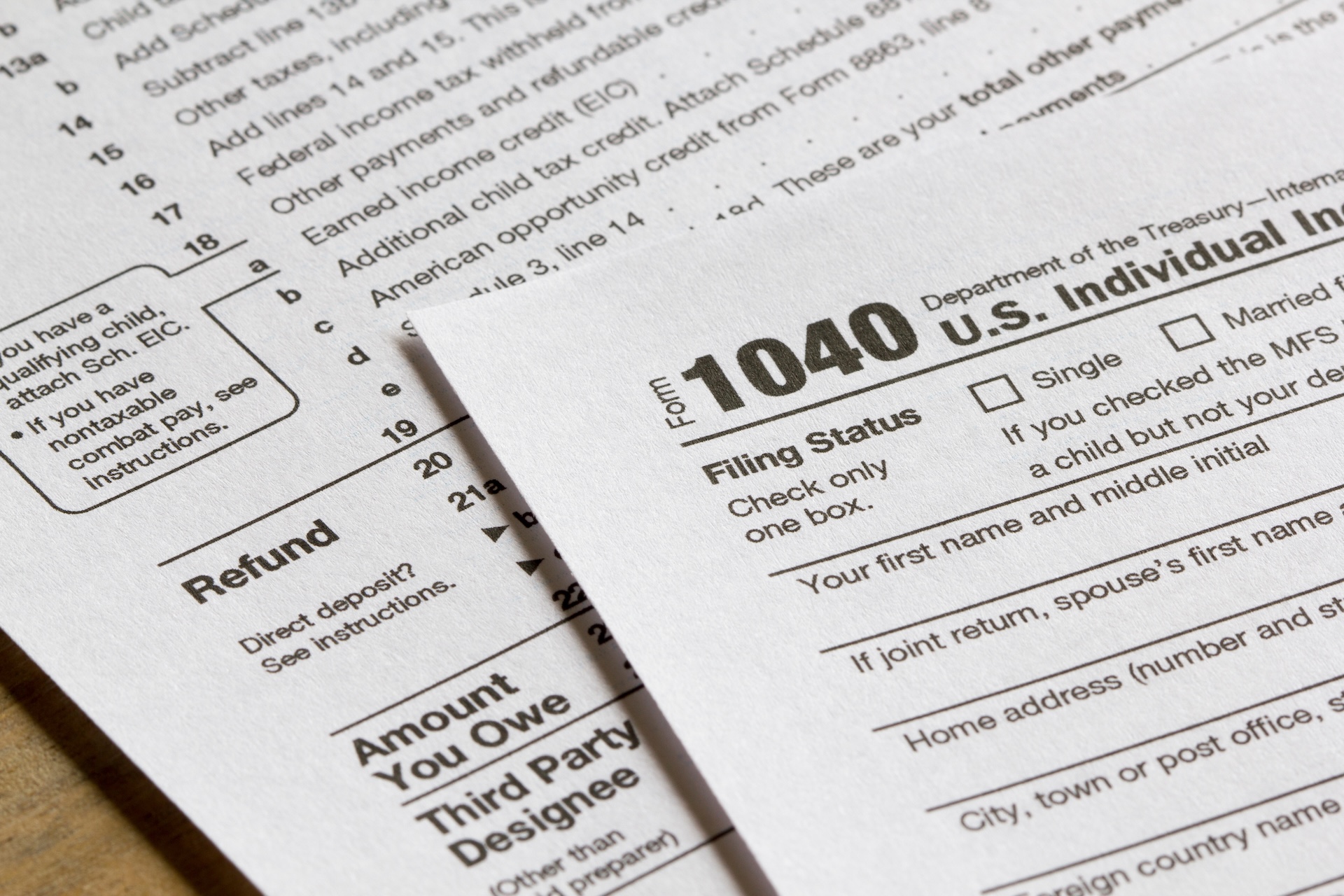
This year we will again be implementing a deadline for all our individual tax return clients to provide us with their tax documents in order for us to get our work completed by the original due date of April 15, 2026.
Please provide your tax documents no later than March 20, 2026. If your tax documents are not received by this date, we will continue to work diligently on your 2025 tax return preparation, but will first file an extension on your behalf and subsequently submit your tax return for filing after the original due date. We thank you in advance for your understanding and cooperation. By complying with our tax document submission deadline, you enable us to maintain the high quality tax services to which you are accustom.
Here are some key items relating to the 2025 tax year filing, and a few for 2026 planning, where cited:
On July 4th, 2025, President Donald Trump signed the One Big Beautiful Bill Act (OBBBA). This bill has several important changes to the 2025 and 2026 tax regime.
Standard deduction is as follows:
- Single $15,750
- Married filing joint $31,500
- Head of household $23,625
Medical expense deduction threshold is 7.5% of adjusted gross income. For NJ, you can deduct unreimbursed medical expenses you paid during the year that are more than 2% of your gross income.
SALT Deduction
For 2025, the $10,000 cap on State and Local Tax (SALT) deductions increases to $40,000 for those earning $500,000 or less. For 2026, the cap increases to $40,400. However, a 30% “haircut” applies for taxpayers in the highest income bracket (modified higher than $500,000 for joint filers and $250,000 for married filing separately, but the deduction would not be reduced below $10,000.) The Pass-Through Business Alternative Income Tax Act (BAIT) is available. This Act allows individuals the opportunity to work around the SALT cap. In order to take advantage, you would have to be an owner of a partnership or S Corporation, and the respective entity would pay the state income tax at the entity level thus receiving a federal tax deduction for the taxes paid.
Mortgage interest deduction is limited to interest paid during the year on the first $1,000,000 of qualified mortgage debt obtained prior to December 16, 2017. If the mortgage was obtained after December 15, 2017, then the mortgage interest deduction is limited to interest paid during the year on the qualified mortgage debt of $750,000. These dollar limits apply to the combined mortgages on your main home and second home.
Mortgage insurance premiums are no longer deductible for 2025 but are deductible for 2026 and beyond.
Charitable contributions are allowed up to 60% of your adjusted gross income (AGI), but in some cases, 20% 30%, or 50% limits may apply. Standard mileage rate is 14 cents per mile driven in service of charitable organizations. For 2026, charitable contributions will be limited by 0.5% of adjusted gross income. In 2026, individuals who do not itemize, but still make a charitable contribution, can receive an above-the-line deduction. This deduction is maximum of $1,000 for single filers and $2,000 for married filing joint filers.
Up to $25,000 of tip income is now deductible, phasing out for higher earners. The deduction starts phasing out at $150,000 of income if single filer, and $300,000 if filing jointly. This deduction is not available to married taxpayers filing separately. This amount is deductible in addition to the standard deduction, so there is no need to itemize.
For everyone whose W-2 reflects overtime pay income, you can deduct up to $12,500 and $25,000 for joint filers with similar phaseout limits to the tip income deduction. This deduction is not available to married taxpayers filing separately.
Taxpayers 65 and older may claim an additional $6,000 deduction through 2028. Although Social Security is still taxable if the deduction is not enough to offset it, and the deduction phases out for seniors making more than $75,000 for a single filer or $150,000 for a joint filer.
Taxpayers (below $100k individual/ $200kjoint) can deduct up to $10,000 in interest paid on U.S. assembled qualifying auto loans.
Miscellaneous itemized deductions are generally limited to the following:
- Gambling losses only to the extent of gambling winnings. In 2026, gambling losses will be limited to 90% of gambling winnings.
- Casualty and theft losses on income-producing property including Ponzi-type investment schemes; Casualty and theft losses on personal-use property only if the loss is attributable to a federally declared disaster.
- Federal estate tax on income in respect of a decedent.
- Amortizable bond premiums on taxable bond
- An ordinary loss attributable to a contingent payment debt instrument or an inflation-indexed debt instrument.
- Deduction for repayment of amounts under a claim of right if over $3,000.
- Certain unrecovered investment in an annuity.
- Impairment-related work expenses of a disabled person.
Educator expense deduction is $300 for 2025.
The age for taking a required minimum distribution from a retirement account is age 73.
Federal child tax credit is $2,200 for children under the age of 17. This amount is subject to phase out limits for modified adjusted gross income limits. New Jersey has a child tax credit of $1,000 per child for ages 5 and under. NJ child tax credit is available to taxpayers with New Jersey taxable income of $80,000 or less.
Federal child dependent care credit has a maximum credit of $3,000 for one qualifying child and maximum $6,000 for two or more qualifying children. New Jersey’s Child and Dependent Care Credit is for taxpayers with taxable income of $150,000 or less.
For 2025 kiddie tax is as follows, the first $2,700 of unearned income qualifies to be taxed at the child’s income tax rate and any amount over that is subjected to the parent’s normal tax bracket.
Energy efficient home improvement credit has an annual credit limit of $1,200, which covers 30% of the costs for items such as windows, skylights exterior doors for property placed in service through 2025.
Clean energy credit for residential energy efficient property is 30% for solar electric, solar water heaters, fuel cells, wind and geothermal energy generating systems for expenditures through 2025.
Clean vehicle credit is $7,500 for new qualifying vehicle purchases and $4,000 for used qualifying vehicles through September 30, 2025.
All or part of retirement income can be excluded pursuant to NJ retirement income exclusion for retirees who are 62 or older with total income $150,000 or less.
NJ Veterans Exemption is $6,000 for 2025.
NJ health insurance mandate requires its residents to maintain health coverage throughout the year, unless the taxpayer qualifies for an exemption. Failure to have coverage may result in a shared responsibility payment.
Qualified business deduction allows taxpayers to deduct up to 20% of their qualified business income. Phase out range for specified service trades or business (SSTB) for 2025 starts at taxable income of $394,600 for married filing jointly and is completely phased out at $494,600. All other filings, phase out range (SSTB) starts at $197,300 and completely phases out at $247,300. If your business income is not from a SSTB, then there is no phase out of the deduction, but a wage / investment limitation applies once income thresholds are met.
Standard business mileage deduction for 2025 is 70 cents per mile and 72.5 cents per mile for 2026.
Business meals are 50% deductible for 2025 and continue to be subjected to strict documentation requirements.
Bonus depreciation is 100% for qualified production property placed in service after January 19, 2025.
Estate tax exemption is $13.99 million per individual (or $27.98 million for a married couple) for 2025; these amounts increase to $15 million per individual (or $30 million for a married couple) for 2026.
Annual gift exclusion is for 2025 and 2026 is $19,000.
The IRS considers digital assets (e.g., Bitcoin) as property for U.S. federal income tax purposes. As such, any transactions in, or transactions that use, digital assets are subject to the same general tax principles that apply to other property transactions.
These are some of the tax provisions that are in effect for the tax year 2025, and future where cited. If you have any questions, do not hesitate to contact us directly.